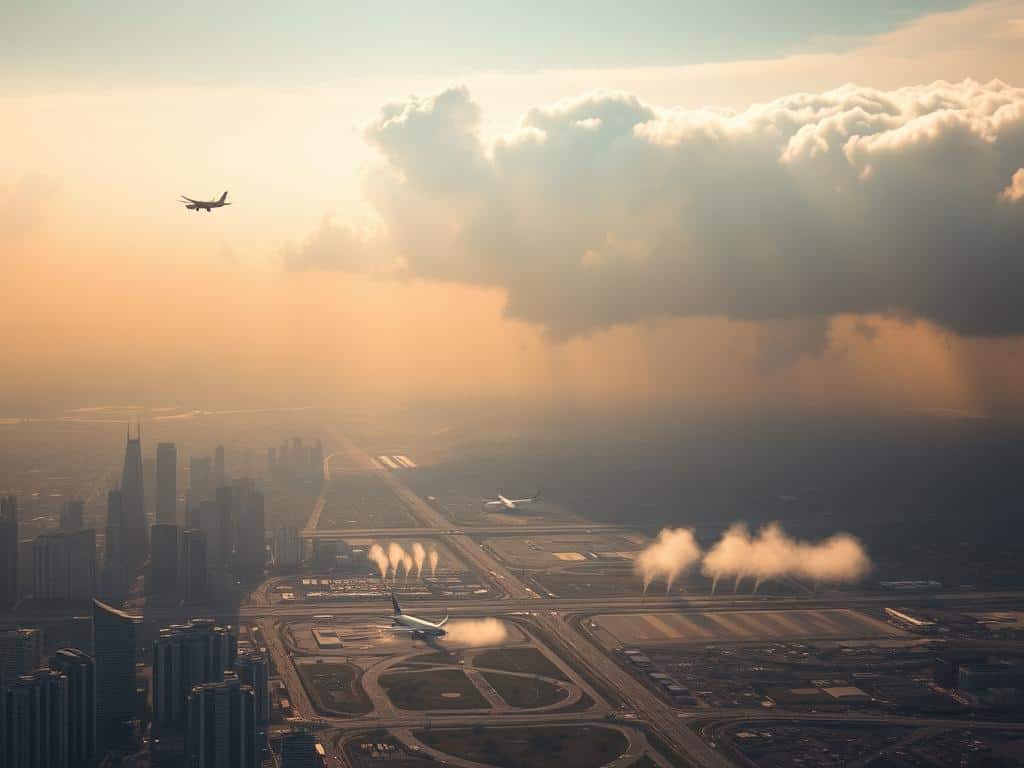
Every time I get on a plane, I feel both excitement and guilt. The joy of starting a new adventure often hides the big environmental problem of air travel. Looking out the window, I see the clouds below and remember that flying affects our planet a lot. The aviation industry is responsible for about 2.4% of global CO2 emissions.
These emissions stay in the air for a long time after we land. It’s a hard truth; flying makes it easy to see family or travel, but it also harms our planet. We need to understand this to make better choices for our future trips. Can we find eco-friendly flights in a world where flying is expected to double in 20 years? The answers are coming.
Key Takeaways
- Air travel accounts for approximately 2.4% of global CO2 emissions.
- Aviation’s impact on global warming reaches up to 5% when considering other harmful emissions.
- While only about 3% of the global population flies regularly, their emissions have significant global consequences.
- Fuel efficiency improvements in aviation are minimal compared to the rising number of flights.
- Understanding aviation’s environmental impact is essential for responsible travel choices.
The Environmental Impact of Air Travel
The aviation industry is a big player in global energy use and carbon emissions. From 1960 to 2019, the number of air travelers jumped from 100 million to 4.56 billion. This growth has made air travel a major source of greenhouse gases, raising concerns about its impact on the climate.
Energy Consumption and Carbon Emissions
Flying uses a lot of energy, mainly from burning fossil fuels. In 2018, it was responsible for about 2.4% of global CO2 emissions. Commercial airplanes and large jets are big contributors, making up 10% of U.S. transportation emissions and 3% of total greenhouse gases.
Jet fuel burning leads to a lot of CO2, with 3.16 kilograms of CO2 produced per kilogram of fuel. As air travel grows, so does the chance for more carbon emissions. This is unless we make changes quickly.
Long-term Climate Effects
The long-term effects of aviation on the climate are serious. By 2050, emissions could triple with more flights. Non-CO2 emissions, like contrails, could make warming effects up to three times worse than CO2 alone.
Aviation’s impact on climate was around 3.5% of total warming in 2011. It’s key to tackle energy use in aviation. Without action, aviation might use over 10% of the carbon budget to keep warming under 1.5°C.
Innovations for Sustainable Air Travel
The aviation industry is changing to reduce its environmental impact. New green aviation technologies, like sustainable aviation fuels and electric aircraft, are key. These changes aim to cut carbon emissions to zero by 2050.
Green Aviation Technologies
Green aviation includes sustainable aviation fuels (SAF). Made from natural sources, these fuels cut carbon emissions by up to 80%. Airlines using these fuels are making a big difference.
But, making enough sustainable aviation fuels without harming food supplies is a big challenge. Investing in making and using these fuels is essential for their success.
The Role of Electric Aircraft
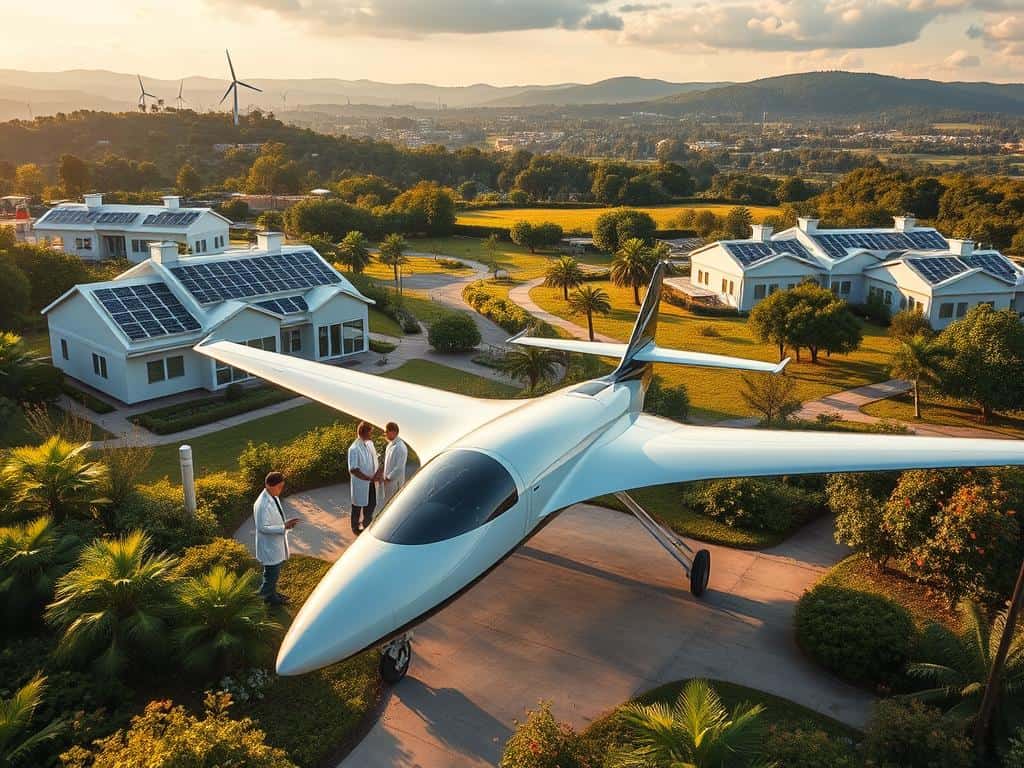
Electric aircraft are leading the way to cleaner air travel, mainly for short flights. Air Canada is working on hybrid-electric planes, hoping to start flying them by 2028. This is a big step towards reducing fossil fuel use in aviation.
Widerøe plans to introduce its first zero-emissions plane by 2026. As electric aircraft designs improve, they show we need cleaner air travel options. This is important as aviation emissions keep rising.
Climate & Aviation: The Growing Challenge
Aviation is a big part of global warming, causing about 2% of all CO2 emissions, says the International Air Transport Association (IATA). It also releases pollutants like nitrogen oxides and particulate matter, making climate change worse and air quality poorer. With more people flying, aviation’s effect on global warming could double by 2050 unless we act fast. We need to use technology and make policy changes to tackle this problem.
Aviation’s Contribution to Global Warming
The aviation industry is connected to climate change through its emissions, which keep going up. Projects like the Airbus E-Fan X and ZeroAvia’s hydrogen-electric flight show how new tech can change aviation’s future. Airlines are starting to use sustainable aviation fuels (SAF), made from renewable materials, to cut down on greenhouse gas emissions. Big airlines plan to use SAF more in the next few years, making it key to their green travel plans.
Strategies for Reducing Flight Emissions
There are many ways to cut down on flight emissions. Making flights more efficient can help a lot. This includes better flight paths, lighter planes, and smarter air traffic control systems like NextGen in the U.S. and SESAR in Europe. Choosing non-stop flights, flying with airlines that have new planes, and using trains instead of planes can also help. Companies that choose remote meetings over travel are making a big difference too, showing how small changes can add up.
Conclusion
The link between air travel and climate change is clear and urgent. Flying is a big part of our lives, but it harms the environment. By 2050, flying could cause a quarter of all emissions, which is alarming.
Choosing sustainable travel options can help a lot. This means picking airlines that use green technology and flying less when we can. Studies show that skipping one flight is like not driving a gas car for a year. This shows how our choices can impact the planet.
Recently, Air Canada bought hybrid-electric planes, showing the industry is moving towards being greener. We all need to focus on flying in a way that’s better for the planet. By doing this, we can make flying more sustainable and protect our future.