As I sit on an airplane, thousands of feet above the ground, the hum of the engines becomes a distant melody. The world below slowly shrinks into sprawling landscapes and tiny cities. I pull out my device and connect to the in-flight Wi-Fi, a lifeline that transcends the isolation of clouds.
It’s remarkable how, in this capsule of metal and technology, I can communicate, work, or stream a movie, all while cruising at 30,000 feet. What was once a luxury has become an expectation, as 82% of travelers now consider reliable in-flight connectivity essential to their journey. Yet with only 25% of aircraft currently equipped with in-flight Wi-Fi, the curiosity remains: how does this complex web of airline tech actually function?
Join me as I unravel the mystery of in-flight Wi-Fi, exploring its evolution from a novelty to a competitive necessity for airlines. This is all supported by the advancements in satellite internet and ground systems.
Key Takeaways
- In-flight Wi-Fi has evolved from a luxury to an expectation for many travelers.
- Currently, only 25% of aircraft provide any form of internet connectivity.
- 82% of passengers express a willingness to fly again based on their Wi-Fi experience.
- The in-flight Wi-Fi industry is anticipated to become a $30 billion market by 2035.
- Airlines use both air-to-ground and satellite-based systems to provide connectivity.
The Evolution of In-Flight Wi-Fi
In-flight Wi-Fi has changed a lot over the years. At first, many saw it as a luxury, not a must-have. Now, with our growing tech needs, airlines are investing more in better internet for flights.
The History of In-Flight Connectivity
Lufthansa was the first to offer in-flight internet, starting on January 15, 2003. Their first flight with Wi-Fi was from Frankfurt to Washington Dulles on a Boeing Sachsen-Anhalt. This was the start of a new era in airline technology.
In December 2013, JetBlue became the first U.S. airline to offer free Wi-Fi on some domestic flights. This move inspired many other airlines to follow. By 2024, airlines like Norwegian, Philippine, and Air New Zealand were also giving free Wi-Fi.
Current Trends in Passenger Connectivity
Airlines are now competing to offer better internet services. JetBlue has been leading with free, unlimited Wi-Fi for over a decade. Norwegian offers unlimited standard Wi-Fi but also premium options for extra cost.
Today, airlines are moving away from in-flight screens. They’re letting passengers stream content on their own devices. This makes entertainment more personal and fun for everyone.
How In-Flight Wi-Fi Works
In-flight Wi-Fi is a technology that keeps us connected in the sky. Airlines use two main ways to offer this service: Air-to-Ground (ATG) and satellite-based systems. Each method affects how well we can stay online during flights.
Two Primary Methods of Connection
There are two main ways to get Wi-Fi on planes. Airlines like Gogo and Panasonic Avionics offer these services. They aim to meet the growing need for internet access in the air.
Air-to-Ground (ATG) Connectivity
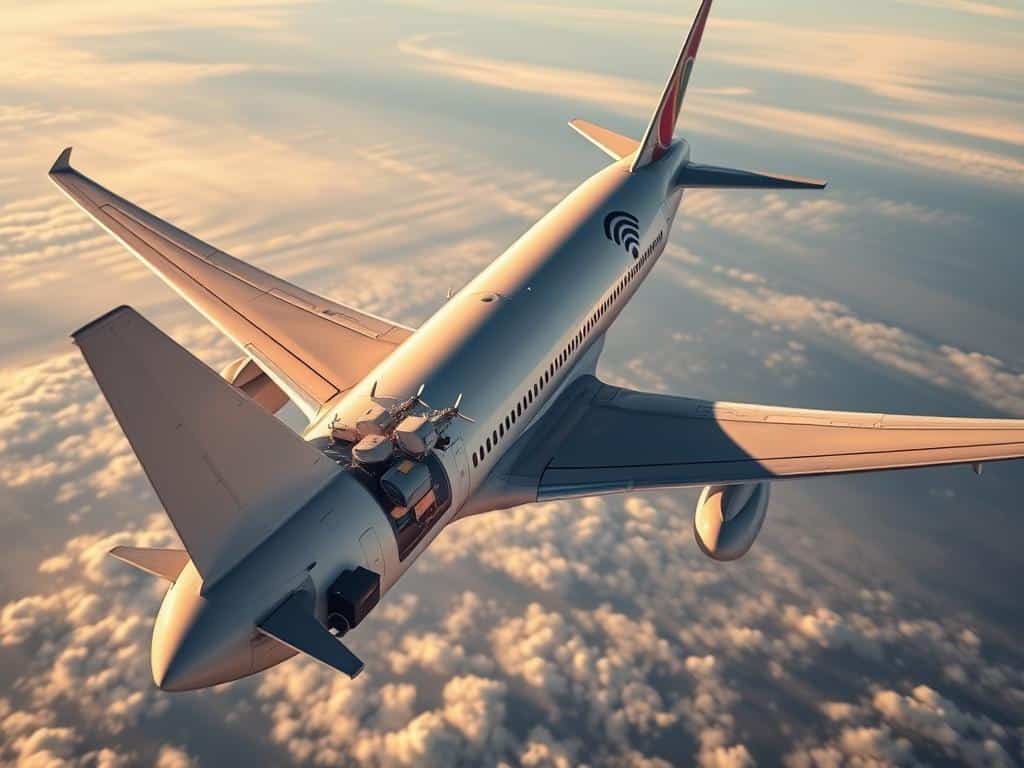
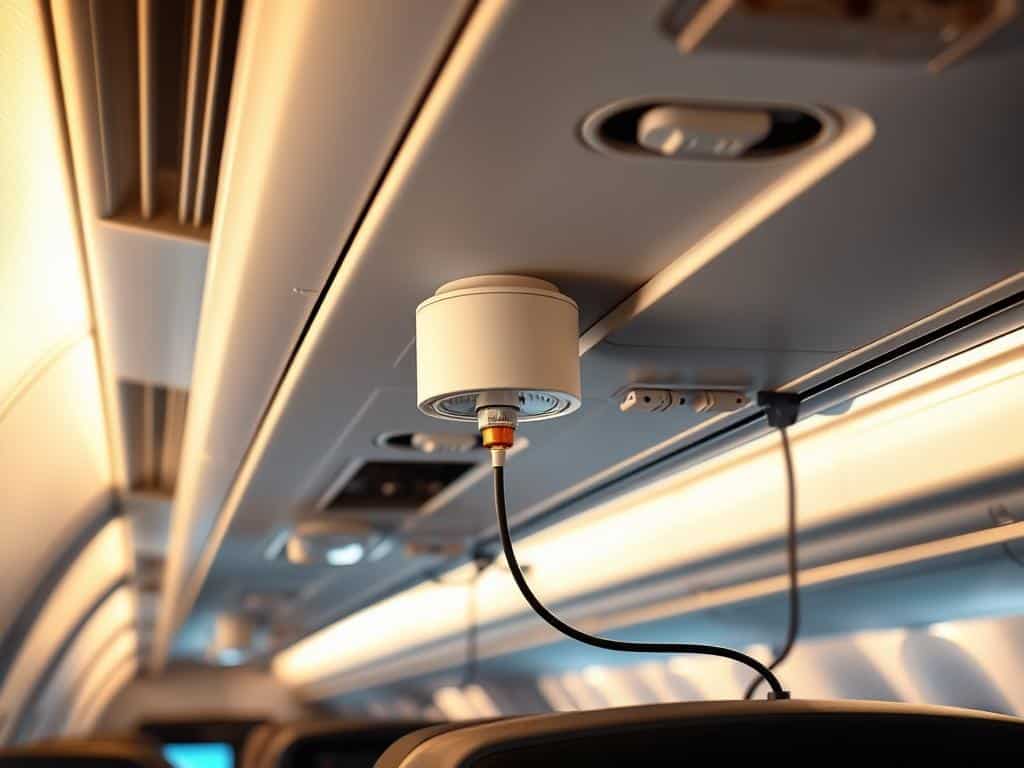
Air-to-Ground (ATG) uses antennas on planes to connect to towers on the ground. It works best near land and offers decent speeds. But, it can have problems with connection and is only available in certain areas.
Many airlines charge about $10 for ATG Wi-Fi. This makes it a budget-friendly choice for travelers.
Satellite-Based Connectivity
Satellite-based Wi-Fi uses satellites in space to cover more areas. It provides faster internet, great for streaming and browsing. But, it can have higher latency.
Companies like Viasat and Gogo’s 2Ku system are working to improve satellite Wi-Fi. Some airlines, like Delta Air Lines and Emirates, are even giving free Wi-Fi to improve customer happiness.
Benefits and Challenges of In-Flight Wi-Fi
In-flight Wi-Fi has changed how we travel. It lets us stay connected at 10,000 feet, making our trips more productive and fun. We can email, watch shows, or plan our next trip, making our journey better.
More than 60% of flyers see internet access as key for their flights. This shows how much people want to stay connected in the air.
The Convenience of Staying Connected
Travelers love the chance to work or enjoy shows online while flying. Almost 70% of leisure travelers want internet on their flights. Airlines offer free Wi-Fi on long flights and paid services for $10 to $30.
Companies are willing to pay more for better internet on flights. This means more options for passengers.
Challenges with Connectivity
Despite its benefits, in-flight Wi-Fi faces challenges. Its speed can vary due to user numbers and technology. Many find it slower than home or work internet.
This can cause problems, like on flights over water using satellite tech. Security is also a big worry. Public Wi-Fi can be risky, so using a VPN is advised for safe browsing.
Conclusion
In-flight Wi-Fi has become a must-have for travelers. It’s not just a luxury anymore. Airlines are now focusing on making sure we stay connected in the air.
This change shows how much we value being online, even when we’re flying. Airlines are working hard to meet our needs. They want to offer better services and make more money from extra fees.
Looking ahead, we can expect even better internet on planes. New technologies will make it faster and more reliable. This will change how we use the internet during flights.
Airlines are spending a lot to improve their Wi-Fi. They know how important it is to stay connected. But, they also face the challenge of keeping costs down while providing good service.
Some airlines, like Emirates, offer free Wi-Fi to their loyal customers. Others, like Delta, are planning to offer free internet too. This shows how competitive the market is.
Even with the current limitations, the future looks bright. Airlines are working hard to improve their internet services. Soon, we’ll all enjoy fast and reliable Wi-Fi on our flights.