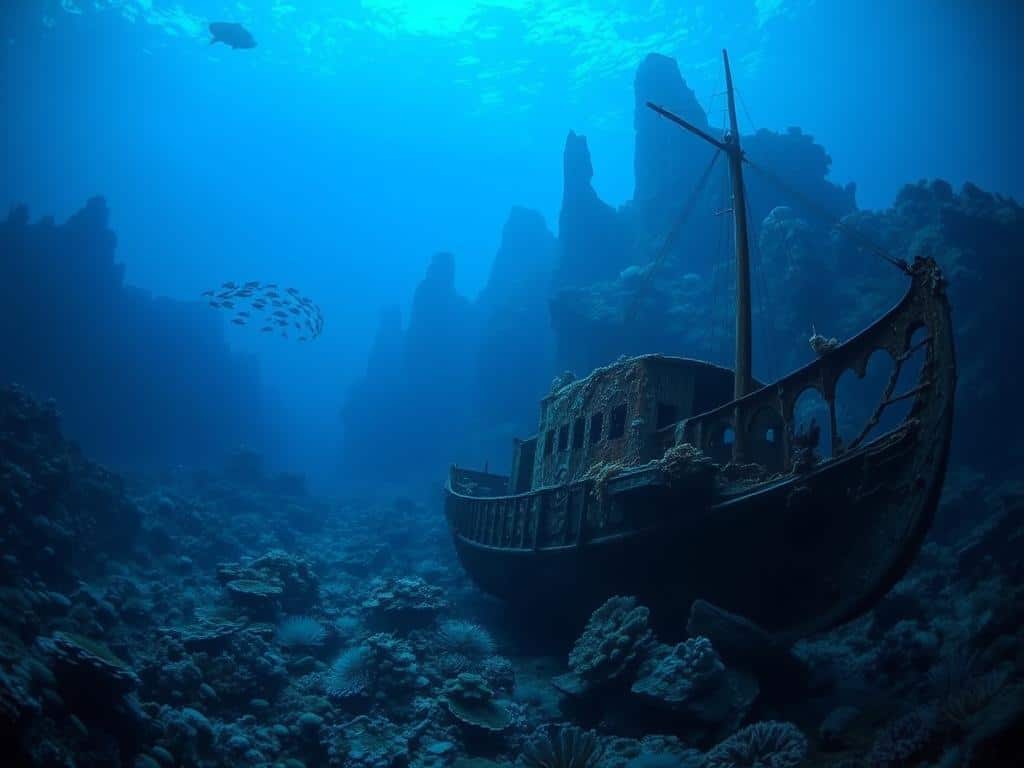
Did you know over 60% of our planet is hidden underwater? The ocean floor is a vast, mysterious place. It goes down over 6,000 meters, where the pressure is incredibly high.
Light is scarce below 1,000 meters. It’s almost completely dark. In this article, we’ll explore the deep sea. We’ll look at the life that exists there and how scientists study it.
Join me as we uncover the secrets of the deep. We’ll discover the wonders that lie beneath the waves!
Key Takeaways
- Over 60% of the Earth’s surface is unexplored underwater.
- At 6,000 meters, the water pressure is 596 atm.
- Below 1,000 meters, it’s very dark, affecting life and ecosystems.
- New technology is essential for exploring the deep sea.
- The deep-sea ecosystems are vital for biodiversity and carbon sequestration.
- Deep-sea mining is a big threat to these habitats.
The Fascinating World of Deep-Sea Exploration
The oceans’ depths are home to incredible marine ecosystems. Exploring these areas shows us amazing adaptations and diversity. Here, we find unique creatures that have evolved to survive in extreme conditions.
Introduction to Deep-Sea Ecosystems
Deep-sea ecosystems exist in deep, dark, and cold environments. As we go deeper, the conditions change a lot. About 75% of the ocean is deep, dark, and cold.
The mesopelagic zone is home to about 90% of the world’s fish by weight. This shows how much life there is below the surface.
The abyssopelagic zone has pressures up to 600 times that of sea level. It’s home to creatures like the bristlemouth fish, with numbers in the quadrillions. The hadalpelagic zone, including the Mariana Trench, is the deepest part of the ocean. It has depths of nearly 36,070 feet.
Innovative Techniques in Deep-Sea Research
Scientists use many new methods to explore these areas. Seismic imaging is like a CT scan but for the ocean floor. It helps us see structures and understand plate tectonics.
Submarine diving and AUVs or ROVs are key in underwater exploration. These tools let us collect data from deep places safely. Recent missions have found new creatures and features using advanced ROVs.
Marine Mysteries and Unveiled Secrets
The oceans are full of mysteries that excite scientists and adventurers. Project Azorian is a key part of this, hidden in Cold War secrets. It aims to explore the deep seas’ treasures and possibilities. This project links to new interests in mining and marine biotechnology.
The Story Behind Project Azorian
Project Azorian was a secret CIA mission in the Cold War. It aimed to find the lost Soviet submarine K-129, which sank in 1968. The CIA used a deep-sea mining cover-up to hide its true goal.
The operation, called the Hughes Glomar Explorer, faced many challenges. It had to keep its mission secret and deal with tough technical issues. Despite these hurdles, it managed to gather important information. The project cost around $500 million and was partially successful, changing marine exploration and espionage.
Hidden Treasures: Minerals and Biotechnology
The ocean’s depths are full of valuable minerals waiting to be found. Deep-sea mining looks for cobalt-rich crusts and other valuable resources. But, we must think about the harm it could cause to the ocean’s delicate ecosystems.
Marine biotechnology is another exciting field. It uses the ocean’s genetic diversity to find new medicines. Finding a balance between using these resources and protecting the ocean is key. It’s important for our planet’s future.
Conclusion
Deep-sea exploration is a thrilling journey into the unknown. It uncovers secrets that help us understand our planet’s complex ecosystems. Yet, only a tiny part of the deep ocean has been explored—less than 0.002% in the last 60 years.
This shows us the mysteries waiting to be discovered. It also highlights the need to focus on deep-sea exploration and ocean conservation. We must explore the deep ocean while protecting it.
Exploring these depths could lead to great discoveries. We might find new medical therapies and sustainable food sources. The discovery of over 5,000 new deep-sea species in the Clarion-Clipperton Zone shows the vast biodiversity we could discover.
But, we must do this exploration responsibly. We need to support initiatives that protect our marine ecosystems. This way, we can use the ocean’s resources wisely.
The balance between exploring and conserving is key. If we’re not careful, we could harm the ecosystems that offer us so much. By focusing on ocean conservation, we protect these wonders for future generations.
This also inspires new scientists to explore the deep ocean. The choices we make today will affect the health of our oceans for years to come.